
A historic gathering at a Lusaka church where Christian choirs, Islamic Nasheed, and a giant shared canvas proved that our differences are what make us whole.
Can people from completely different faiths and backgrounds come together to create a single, unified masterpiece? On April 22, a deeply moving answer unfolded at Hillcrest Baptist Church in Ibex Hill, Lusaka.
Co-hosted by the HWPL Zambia Branch and the MUZU Arts Collective, the "Art & Peace Talk Zambia" event brought together religious leaders, passionate youth, and local community members.
Aligning beautifully with President Hakainde Hichilema's “Brand Zambia Initiative”—which champions national unity and social cohesion—this unique program showed how individual, scattered "pieces" can genuinely connect to form a beautiful, lasting "peace."
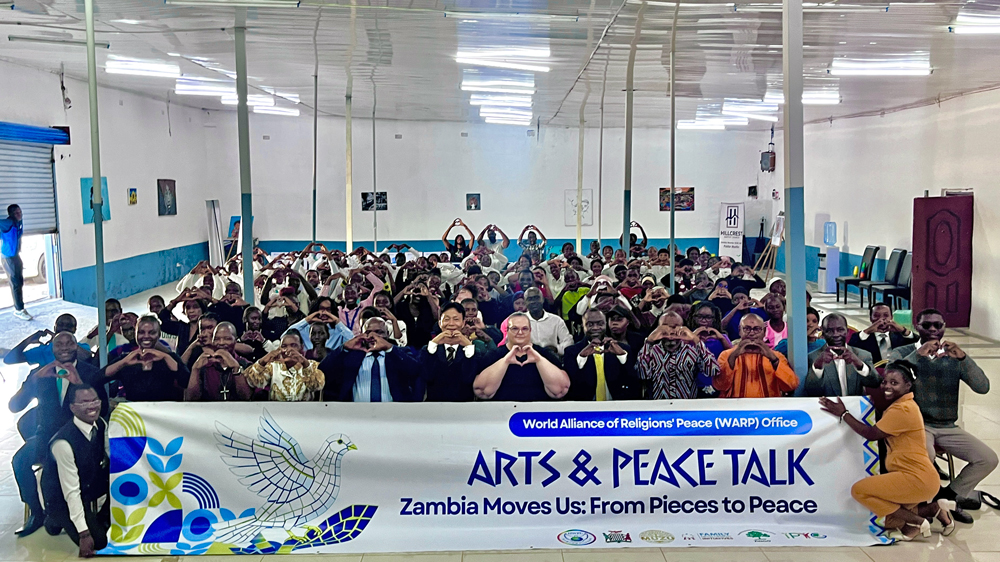
Long before the opening remarks echoed through the hall, the atmosphere was already buzzing with collaborative energy. Right in the lobby, a massive, blank canvas stood waiting for the arrivals. One by one, attendees picked up brushes and filled the empty spaces with their own visual definitions of harmony.
Watching separate brushstrokes and contrasting colors slowly bleed into a cohesive, breathtaking mural was a living metaphor for peacebuilding. Alongside this community canvas, professional displays by the MUZU Arts Collective lined the walls, grounding the venue in a visual language that bypassed words entirely.
When a Church Choir and Islam Nasheed Share the Same Stage
Perhaps the most unforgettable highlight of the event was the sacred music session. In a beautiful display of interfaith harmony, the soaring melodies of a Christian choir were followed immediately by the rhythmic, soulful verses of an Islamic nasheed—all under the roof of the same Baptist sanctuary.
"Peace is not merely the absence of conflict, but the presence of solidarity, dialogue, and mutual respect. Art as a profound tool that transcends language, connecting human hearts in the ultimate pursuit of building peace." — From the HWPL Opening Address
The beliefs and modes of expression differed, but the underlying heartbeat was identical. It wasn't just a performance; it was a profound, demonstration of harmony that left everyone in the room deeply moved.


"What is the Key Connection That Enables Us to Become One?"
The emotional high of the music set a perfect stage for the interfaith dialogue panel, where leaders from Christianity, Islam, the Baha'i Faith, and Hinduism dove straight into the core mechanics of human connection.
Sheikh Yussuf Ayami (Islam, Team Leader of FDI): "Universal values like respect, compassion, and justice—all rooted in our shared humanity—are the golden threads that naturally connect us."
Swami Divyabodhananda (Hinduism, Representative of Ramakrishna Vedanta Center): "True unity doesn't require us to be identical. It arises when we look past cultural and religious differences to recognize a deeper, spiritual oneness."

Peace: The Ultimate Determinant of Community Health
The dialogue quickly expanded to include local civic leaders and the younger generation. Mr. Victor Kagoli, Director of the Public Health Department for the Lusaka City Council, brought a fascinating and grounded civic perspective to the table, connecting social harmony directly to physical well-being.
"Communities that are united, inclusive, and respectfully are inherently healthier and more resilient. Peace isn't just a social ideal; it is a vital determinant of public health."
Moving From Fragments to Wholeness
Since 2017, HWPL has quietly and laid the groundwork for religious cooperation in Zambia through its World Alliance of Religions' Peace Offices. This event, however, marked a refreshing new chapter—injecting the vibrant energy of fine art and music into grassroots peacebuilding.
By showing that individual fragments (pieces) can beautifully interlock into a grand design (peace), the youth and leaders of Lusaka have offered a powerful blueprint for the rest of the world.
HWPL official website


0 개의 댓글:
Post a Comment